
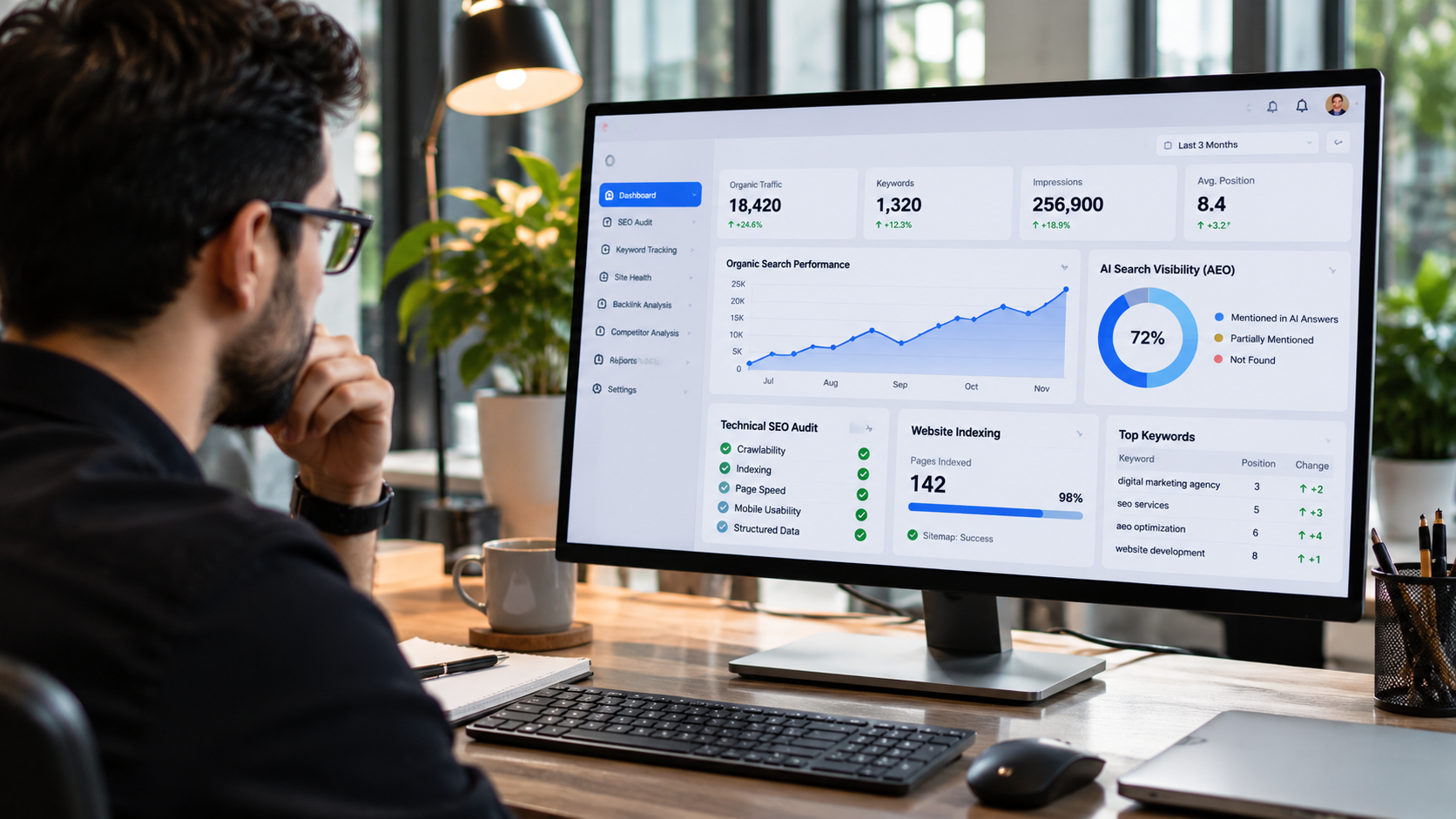
Your website looks professional. Your services are listed, and you’ve published helpful content. Yet the phone stays quiet, Google traffic is thin, and competitors keep showing up when people ask AI tools for recommendations.
This usually isn’t a design problem or a content-volume problem. It’s a visibility problem. Something is stopping search engines, AI tools, or customers from finding, understanding, or trusting your business.
An SEO and AEO audit shows you exactly what that something is. In this guide, you’ll learn:
- What an SEO and AEO audit checks
- The most common reasons businesses stay hidden online
- How to fix issues in order of business impact
- How to measure whether your fixes are working
Quick takeaway: Most visibility problems come from a few areas: pages that can’t be indexed, content that misses search intent, unclear service pages, weak trust signals, and inconsistent business information. An audit finds these gaps before you spend money on new content or a redesign.
What Is an SEO and AEO Audit?
An SEO and AEO audit is a structured review of how easily search engines, AI-powered answer tools, and customers can find, understand, and trust your business online. It identifies technical, content, and credibility issues that limit your visibility and leads.
- SEO (search engine optimization) improves your visibility in traditional search results, like Google’s organic listings.
- AEO (answer engine optimization) improves how your business appears in AI-generated answers, such as AI Overviews, ChatGPT, and other conversational search tools.
Both depend on the same foundations: accessible pages, clear content, accurate business details, and real proof of expertise.
Why Can’t Customers Find My Business Online?
Customers usually can’t find a business online because key pages aren’t indexed, content doesn’t match what people search for, or competitors explain their services more clearly and credibly. In many cases, several small issues combine into one big visibility gap.
AI search adds another layer. A customer might search Google for “web design agency near me,” then ask an AI assistant which agency fits their project. Those two searches use different questions and often pull from different sources.
Your website needs to answer both: what you offer and why someone should choose you.
1. Can Search Engines Access Your Website?
If search engines can’t crawl or index your pages, those pages can’t rank, no matter how good the content is. Technical accessibility is the first thing to check.
How do you check if Google has indexed your pages?
Open Google Search Console and review the Pages report. Confirm your main service pages are indexed, then look for:
- Pages accidentally marked noindex
- Broken pages and incorrect redirects
- Duplicate or conflicting page versions
- Incorrect canonical URLs
- Mobile usability problems
- Content hidden from search engines
Also review your XML sitemap and internal links. Your key service pages should be reachable from your homepage and main navigation, not buried behind an old blog post.
Takeaway: Technical fixes don’t guarantee rankings, but nothing else works without them.
2. Does Your Content Match Search Intent?
Search intent is the reason behind a search. Matching it means giving people the type of page they expect, whether they want to learn something or hire someone.
Picture a commercial cleaning company. Someone searching “what is commercial cleaning” wants information. Someone searching “commercial cleaning company in Toronto” wants a quote. Same industry, very different needs.
What’s the difference between informational and commercial searches?
- Informational searches help people understand a problem or topic. Blog posts serve these best.
- Commercial searches help people compare providers and make decisions. Service pages serve these best.
Connect the two with internal links. A helpful article can explain a problem, outline solutions, and point readers to the right service page when they’re ready.
3. Are Your Service Pages Easy to Understand?
A strong service page tells visitors what you do, who it’s for, and how to get started within seconds. Vague language like “innovative digital solutions” forces customers to guess, and most won’t.
Every service page should answer five questions:
- What service do you provide?
- Who is it for?
- Which problems does it solve?
- What does your process involve?
- How can customers get started?
Use descriptive headings and plain language. “SEO services for small businesses” beats “advanced visibility solutions” every time. Add testimonials, project examples, or results you can support.
Common mistake: Leading with industry jargon. Fix: Explain the service first, then introduce technical terms.
Clear service pages help customers decide faster. They also give AI systems an accurate picture of what your business offers.
4. Are You Answering the Questions Customers Actually Ask?
Content performs best when it answers real questions customers ask before buying, not when it chases keywords.
A business considering SEO help might ask:
- Why isn’t my website showing up on Google?
- Why do competitors rank ahead of me?
- Can AI search tools find my services?
- Should I update existing pages or write new ones?
How should you structure answers for featured snippets and AI tools?
Lead with a direct, one- or two-sentence answer. Then add context, examples, and next steps. This format helps readers skim and makes your content easier for search engines and AI tools to extract.
Use natural language and related terms instead of repeating one keyword. An article about website visibility might cover indexing, business listings, content relevance, and search performance. You don’t need a separate page for every small variation of a question.
5. Does Your Website Show Real Credibility?
Trust signals are the proof that your business is real, experienced, and reliable. They influence both customer decisions and how search systems judge the quality of your information.
Strengthen credibility with:
- Authentic client testimonials
- Case studies and completed projects
- Clear company and contact details
- Accurate descriptions of your expertise
- Original photos and examples
- Consistent business information across platforms
Never invent reviews or make performance claims you can’t back up. A specific case study showing how you improved a client’s website carries far more weight than a promise of guaranteed results.
If your service pages lack depth, professionally written search-friendly website content can make your expertise easier to see.
6. Is Your Local Business Information Accurate?
Local SEO helps nearby customers find you when they search by service and location. It depends on accurate, consistent business details across your website and listings.
What should you check in your Google Business Profile?
Review your business name, address, phone number, categories, services, and website link. Keep everything consistent with your website. Add original photos and respond professionally to reviews.
On your website, clearly state the areas you serve. Create location pages only where they offer genuinely useful, unique information. Dozens of near-identical city pages rarely help and can hurt.
7. Is Your Website Fast and Easy to Use?
Page speed and user experience decide whether visitors stay long enough to contact you. Visibility gets people to your site. Usability turns them into leads.
Test your site on a phone and ask:
- Can people read content without zooming?
- Are buttons easy to tap?
- Does the contact form work?
- Can someone find your main services in a few seconds?
Run key pages through Google PageSpeed Insights. Compress large images, remove unnecessary scripts, and fix layout shifts. Don’t strip out useful content just to chase a perfect score. The goal is a faster, clearer experience for real visitors.
8. How Visible Is Your Business in AI Search?
AI search visibility is how often, and how accurately, your business appears in answers from AI tools like Google AI Overviews and ChatGPT. It matters most for conversational searches, such as “Which agency can help a small business get more organic leads?”
How do you check your AI search visibility?
- List 10–15 realistic questions your customers might ask.
- Run them across the AI tools your customers use.
- Record whether your business appears, whether the details are accurate, and which sources are cited.
- Compare those results with your website. Look for missing services, inconsistent details, or a lack of original examples.
Results vary between platforms and can change from one search to the next. No one can guarantee placement in AI answers.
Do you need special AI optimization tactics?
No. Google has stated that its AI search features don’t require special AI-only structured data. Skip shortcuts like keyword stuffing or mass-produced articles. Accurate information, accessible pages, and genuinely useful content support both traditional SEO and AI visibility.
9. How Should You Measure SEO and AEO Success?
Measure success by qualified leads and conversions, not rankings alone. A site can gain traffic without gaining a single new customer.
Track these metrics:
- Organic clicks and impressions
- Visibility for commercial, high-intent searches
- Traffic to service pages
- Contact form submissions and calls
- Qualified inquiries and conversions
- AI search mentions and citations, where measurable
Use Google Search Console for search performance and analytics with conversion tracking for visitor actions. AI visibility checks add useful context, but they shouldn’t replace business metrics.
10. Which SEO Issues Should You Fix First?
Fix issues in order of business impact: technical blockers first, then service pages, then supporting content, then ongoing refinement.
- Fix serious technical problems. Resolve indexing errors, broken service pages, and faulty redirects.
- Improve commercial service pages. Sharpen headings, explain benefits, and make contact options obvious.
- Strengthen supporting content. Answer customer questions, refresh outdated posts, and link them to relevant services.
- Monitor and refine. Use real search data and customer behavior to guide your next steps.
This order keeps your effort focused on changes that affect leads, instead of treating every recommendation as equally urgent.
When Should You Get a Professional SEO and AEO Audit?
Get a professional audit when your website isn’t producing leads and you don’t know why. Common warning signs include:
- Little or no organic traffic
- Rising traffic but flat inquiries
- Competitors ranking for your core services
- Missing or inaccurate details about your business in AI answers
- A recent redesign or URL changes
- Ongoing SEO spending without clear reporting
A good audit explains each problem, its likely impact, and what to do next. It also separates confirmed issues from opportunities that need testing. Be cautious of any provider promising guaranteed rankings or guaranteed AI mentions.
Frequently Asked Questions
What is the difference between SEO and AEO?
SEO improves your visibility in traditional search results. AEO improves how your business appears in AI-generated answers and conversational search tools. Both rely on accessible pages, clear content, and trustworthy business information.
What does an SEO and AEO audit include?
A complete audit reviews technical health, indexing, search intent, service-page content, internal linking, local business listings, trust signals, and AI search visibility. It ends with a prioritized action plan.
Can AI tools like ChatGPT recommend my business?
Yes, AI tools can mention businesses when they find clear, consistent, and credible information about them. Accurate service descriptions, reviews, and consistent listings improve your chances, but inclusion is never guaranteed.
Why is my website not showing up on Google?
Common causes include pages blocked from indexing, technical errors, thin or unclear content, and weak relevance to what people search. Google Search Console is the fastest place to start diagnosing the issue.
How long does an SEO and AEO audit take?
Timing depends on your site’s size and complexity. A small business website takes far less time than a large online store. Implementing fixes and seeing measurable results takes additional weeks or months.
Find Out What’s Holding Your Website Back
Your website should help customers find you, understand what you do, and feel confident reaching out. When it doesn’t, the cause is usually specific and fixable: an indexing error, an unclear service page, missing trust signals, or inconsistent business details.
At Custom Studioz, we help businesses uncover those gaps through SEO strategy, technical optimization, and content improvements built for both traditional and AI-powered search.
Learn more about our SEO and AEO audit services, or contact Custom Studioz to talk through your visibility goals and get a clear plan for what to fix first.