
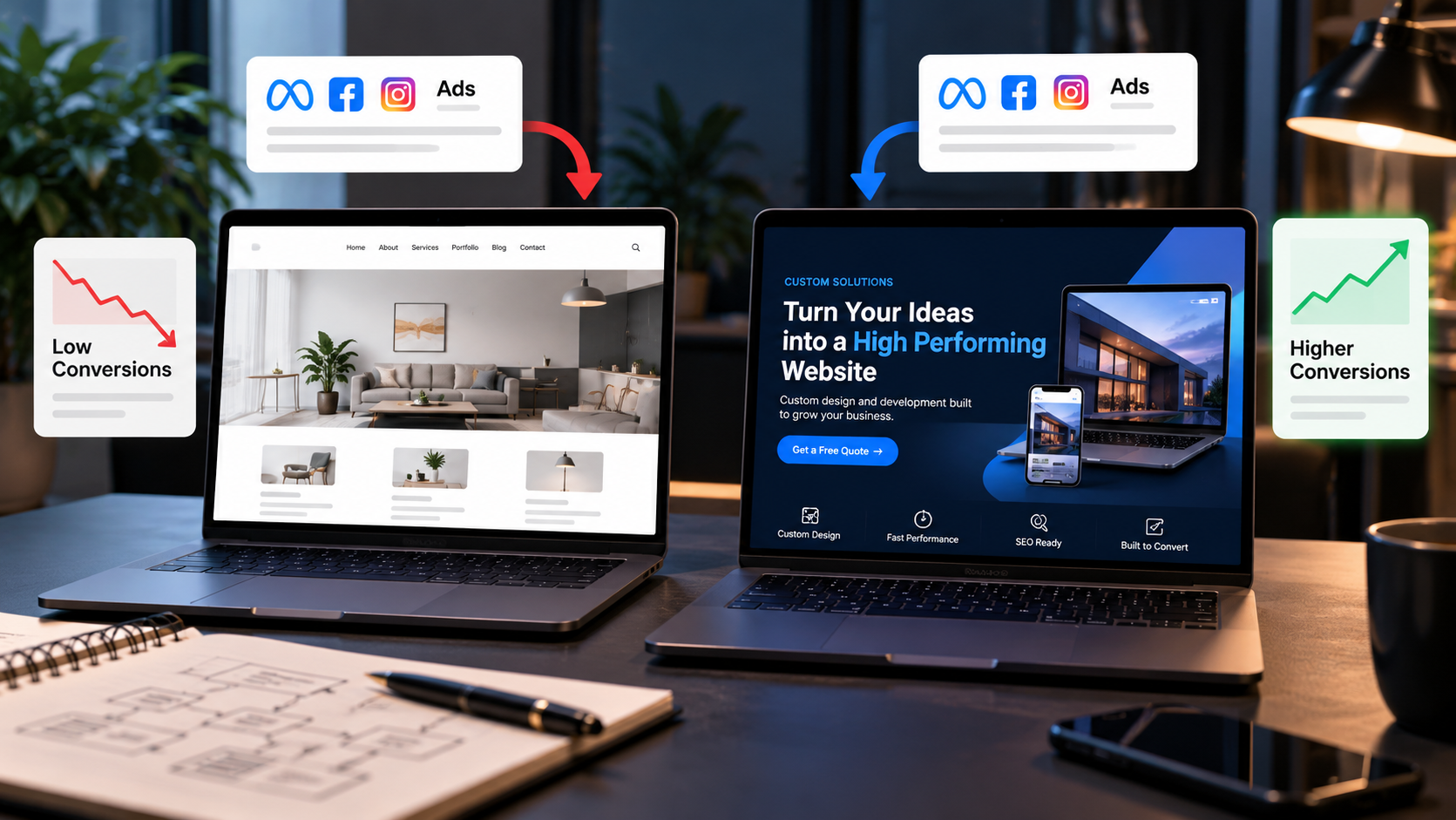
Some days you check your ad dashboard and just feel stuck. The clicks are coming in, but the leads aren’t. You’re paying for traffic, and that traffic seems to vanish the second it lands on your site.
We’ve seen this happen to a lot of business owners. Most of the time, the ads aren’t the problem. The problem is where those ads send people.
Often, that’s a homepage. Homepages are great for many things, but they’re not built to turn a paid click into a lead. That’s where custom landing page funnels come in. In this guide, we’ll walk you through why they work, how they’re built, and how you can stop wasting ad spend on homepages for good.
The Real Problem With Sending Ad Traffic to Your Homepage
Your homepage tries to talk to everyone. It covers your services, your story, your team, your blog, and maybe your latest news. That’s fine for someone who found you on their own and wants to look around.
However, a paid visitor is different. They clicked one specific ad with one specific message. They came for one thing, and they want to find it fast.
Too Many Choices Kill Momentum
When someone lands on a busy homepage, they see menus, links, and buttons pointing in every direction. Each one is a chance to wander off. As a result, many visitors never take the action you actually paid for.
Here’s what usually pulls attention away on a typical homepage:
- Navigation menus with five to ten different links
- Blog posts and news sections
- Social media icons that lead off your site
- Several competing calls to action
- General copy that doesn’t match the ad
The Message Doesn’t Match the Ad
Let’s say your ad promises a free quote on kitchen remodeling. Then the visitor lands on a homepage about “full-service home solutions.” That small gap creates doubt. People start wondering if they clicked the wrong link.
This disconnect hurts ad relevance and user intent. Visitors expected one thing and got something else. So they leave, and you pay for that click anyway.
What Are Custom Landing Page Funnels for Paid Ads?
Custom landing page funnels for paid ads are focused pages built for one campaign and one goal. They match your ad’s message, speak to one audience, and guide visitors toward one clear action.
This isn’t about building a fancy website. It’s about building a simple path from “I clicked” to “I’m in.”
How a Funnel Differs From a Single Page
A landing page is one page. A funnel is the full journey. It might include a landing page, a short form, a thank-you page, and a follow-up email.
Each step has a job. Together, they move people forward without making them think too hard. Here’s a simple example:
- Ad: A visitor sees your offer on Facebook or Instagram.
- Landing page: They arrive on a page that matches the ad exactly.
- Lead form: They fill out a short, easy form.
- Thank-you page: They get confirmation and a clear next step.
- Follow-up: They receive an email or call that keeps the conversation going.
You can learn more about how we build custom landing page funnels for paid ads that fit your goals.
5 Reasons Custom Landing Pages Outperform Homepage Links
Now let’s get into why focused funnels win. These reasons are simple, but together they make a big difference in your results.
1. Higher Conversion Rates
A conversion rate tells you how many visitors take the action you want. Custom landing pages usually convert better because they remove distractions. There’s one message, one offer, and one button.
When people don’t have to hunt for the next step, they’re more likely to take it. It’s really that simple.
2. Better Ad Relevance and Quality Score
Ad platforms reward you when your ad and landing page match. On Google Ads, this shows up as your Quality Score. Google looks at expected click-through rate, ad relevance, and landing page experience.
A higher score can mean lower costs and better ad placement. You can read more in Google’s guide to Quality Score. Meta uses similar signals to judge whether your ad delivers a good experience for paid social users.
3. Stronger Match With User Intent
Every click comes with intent. Someone searching for “emergency plumber near me” wants help now. They don’t want to read your company history first.
A custom page answers that intent right away. It shows the visitor they’re in the right place, and it gives them an easy way to act.
4. Clearer Tracking and Smarter Decisions
With a homepage, it’s hard to know which ad drove which result. Traffic gets mixed together. As a result, your data turns muddy and hard to trust.
With dedicated pages, each campaign has its own home. You can see exactly what’s working and what isn’t. That makes funnel optimization much easier over time.
5. Room to Test and Improve
Testing a homepage is risky because so many people use it for different reasons. Testing a landing page is low stakes. You can try new headlines, images, or CTAs without touching your main site.
Small tests add up. Over a few months, those tweaks can lift your lead generation in a real, measurable way.
High Converting Landing Page Design for Meta Traffic
Meta traffic behaves a little differently than search traffic. People on Facebook and Instagram weren’t looking for you. They were scrolling, and your ad caught their eye.
That means your page needs to grab attention quickly and keep it. High converting landing page design for Meta traffic focuses on speed, clarity, and mobile comfort.
Design for Mobile First
Most paid social clicks happen on phones. So your page should look great on a small screen before anything else. Keep text short, buttons big, and forms easy to fill out with a thumb.
Keep It Fast
Slow pages lose people. If your page takes too long to load, many visitors will just tap back to their feed. Compress images, limit heavy scripts, and keep the layout clean.
Match the Ad’s Look and Feel
If your ad uses certain colors, images, or phrases, carry them onto the page. This visual match tells visitors they’re in the right spot. Consequently, they feel more comfortable taking the next step.
Key Elements That Work Well for Meta Ads
Here’s a quick checklist you can keep in your back pocket:
- A headline that repeats the ad’s main promise
- A short subheadline that explains the benefit
- One clear CTA button above the fold
- Social proof like reviews or client logos
- A simple form with three to five fields
- Trust signals such as guarantees or security badges
- No main navigation menu to pull people away
How to Stop Wasting Ad Spend on Homepages
If you’re still sending paid clicks to your homepage, don’t worry. You’re not alone, and the fix is easier than you might think. Here’s a simple way to make the switch.
Step 1: Audit Your Current Campaigns
First, look at where each ad currently sends people. Note your cost per click, conversion rate, and cost per lead. This gives you a baseline to measure against later.
Step 2: Group Campaigns by Offer
Next, sort your ads by what they promise. A free consultation ad and a product discount ad need different pages. Each offer deserves its own focused destination.
Step 3: Build One Page Per Offer
Then create a landing page for each group. Keep the message tight and the design simple. Remember, one page, one goal.
Step 4: Connect the Funnel
After that, link your forms to your email or CRM tool. Set up a thank-you page and a quick follow-up. This keeps leads warm instead of letting them go cold.
Step 5: Test, Measure, and Adjust
Finally, watch your numbers for a few weeks. Compare them to your baseline. Then make small changes and keep what works.
When you stop wasting ad spend on homepages, every dollar starts pulling more weight. You’re not spending more. You’re just spending smarter.
Inside Custom Studioz Ad Funnel Architecture
We know building funnels can feel like a lot. That’s why we keep our process simple and clear. Custom Studioz ad funnel architecture is built around one idea: every click should have a clear path forward.
Our Simple Approach
Here’s how we usually work with clients:
- Discovery: We learn about your business, your offer, and your ideal customer.
- Strategy: We map out the funnel steps and match them to your ad campaigns.
- Design: We create clean, mobile-friendly pages built for PPC traffic and paid social.
- Copy: We write clear messaging that matches your ads and speaks to user intent.
- Launch and tracking: We set up analytics so you can see exactly what’s working.
- Ongoing optimization: We test and tweak to improve your results over time.
Why This Structure Works
Custom Studioz ad funnel architecture doesn’t rely on guesswork. Instead, each piece connects to the next with a clear purpose. Your ads, pages, and follow-ups all work together instead of pulling in different directions.
The result is less wasted spend, better leads, and a lot less stress when you check your dashboard. If you want to dig deeper, check out our tips on conversion rate optimization for more ideas.
Common Mistakes to Avoid
Even with a custom page, a few slip-ups can hold you back. Watch out for these:
- Too many form fields: Long forms scare people off. Ask only for what you really need.
- Weak CTAs: “Submit” doesn’t inspire anyone. Try “Get My Free Quote” instead.
- No social proof: People trust other people. Add reviews or testimonials.
- Ignoring mobile: A page that looks great on desktop can break on phones.
- Never testing: Your first version is just a starting point, not the finish line.
Let’s Build a Funnel That Actually Works for You
You’ve already done the hard part. You’re running ads and getting clicks. Now it’s time to make sure those clicks actually turn into customers.
We’d love to help you build a funnel that fits your business and your budget. No pressure and no complicated jargon. Just a simple conversation about what you need and how we can help.
Contact Custom Studioz today and let’s turn your ad spend into real, steady leads.
Frequently Asked Questions
Why shouldn’t I send paid ad traffic to my homepage?
Homepages have too many links and messages competing for attention. Paid visitors want one specific thing. A focused landing page matches your ad, removes distractions, and guides visitors toward one clear action. This usually leads to better conversion rates and lower cost per lead.
What makes a landing page funnel different from a landing page?
A landing page is a single page with one goal. A funnel is the full journey, including the landing page, form, thank-you page, and follow-up messages. Each step moves visitors closer to becoming customers.
Do custom landing pages improve Quality Score?
They can. Google considers landing page experience and ad relevance when calculating Quality Score. A page that closely matches your ad and loads quickly often supports a higher score. That can lower your costs and improve ad placement.
How many landing pages do I need for my ad campaigns?
A good rule is one landing page per offer or audience. If you run ads for different services or promotions, each one should have its own focused page. This keeps your message clear and your tracking accurate.